Offshore Seismology and Geophysics
Overview
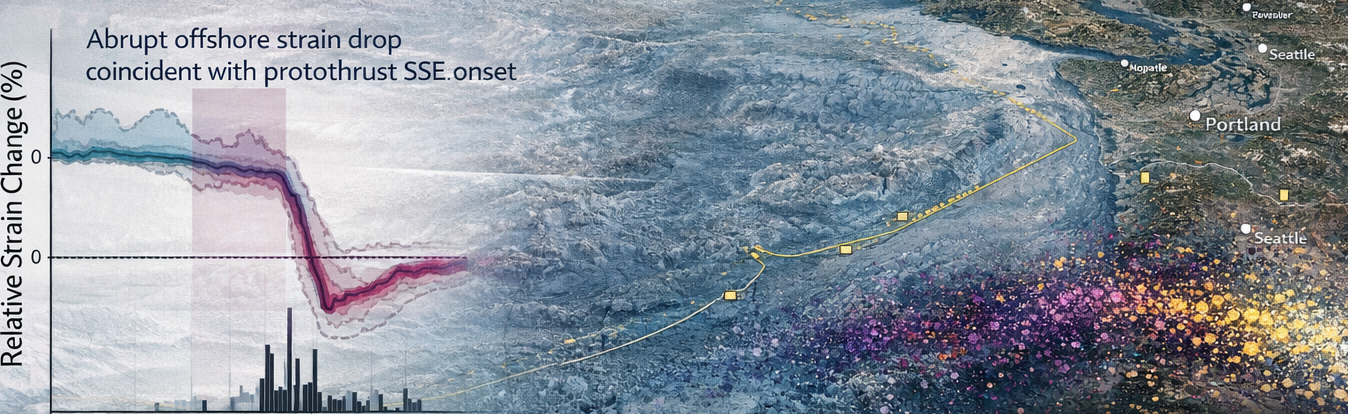
Offshore seismology and geophysics represent a frontier in Earth science where we investigate processes beneath the ocean floor and within the water column. The Denolle Lab develops and applies innovative methods to study offshore earthquakes, aseismic deformation, and submarine hazards using ocean-bottom seismometers (OBS), Distributed Acoustic Sensing (DAS), and other marine geophysical instrumentation.
The marine environment presents unique challenges and opportunities for seismological research. Ocean-bottom instruments (seismometers and DAS) capture signals from earthquakes, ambient ocean noise, and seafloor processes that are critical for understanding plate tectonics, marine hazards, and the coupling between the solid Earth and the ocean.
Research Focus
Our offshore seismology research encompasses several complementary directions:
Ocean-Bottom Sensor Networks
We work with data from ocean-bottom seismometer deployments to study offshore earthquakes, submarine fault systems, and seafloor structure. These instruments provide crucial observations in regions that are otherwise inaccessible, including subduction zones, mid-ocean ridges, and offshore transform faults.
Ambient Noise in Marine Environments
Ocean noise is generated by complex interactions between waves, currents, and seafloor topography. We leverage this ambient noise as a natural seismic source to image subsurface structure, monitor temporal changes, and understand ocean-solid Earth coupling.
Submarine Hazard Assessment
Offshore earthquakes and landslides pose significant tsunami and infrastructure hazards. Our research aims to improve detection, characterization, and monitoring of these submarine geohazards through advanced seismic analysis and machine learning techniques.